The question we asked
We act as external auditor and reporting accountant to a single-academy trust for the year ended 31 August 2026. During our work, a question came up that many trusts will recognise.
The trust organises UK and overseas educational trips. Parents pay the trust through an online payment system, the money goes into the trust's bank account, and the trust contracts with and pays the tour operators and other suppliers directly. Several trips cost more than £25,000.
The trust's own Financial Procedures Manual requires:
- three written quotations for purchases between £5,000 and £25,000
- a formal tender and Finance and Audit Committee approval for purchases of £25,000 and above
No tenders were obtained for the trips that met the tender threshold. The trust's view was that, because the trips were paid for by parents rather than by grant, the value for money and procurement requirements did not apply.
We asked the DfE three questions:
- Do the Academy Trust Handbook's requirements on value for money, competitive procurement and following the trust's own financial regulations apply to trips funded wholly by parents?
- Is there any exemption for parent-funded trips, and should a trust follow its own procedures where they make no exception for trips?
- How should a reporting accountant treat a missed tender or quotation when forming the regularity conclusion?
For the year ended 31 August 2026, the DfE confirmed that the relevant requirements are those in the Academy Trust Handbook 2025, which took effect from 1 September 2025. The paragraph references below are to that edition.
1. The Academy Trust Handbook applies, whoever pays
The DfE does not consider that spending is excluded from a trust's procurement arrangements just because the money came from parents rather than from General Annual Grant or another DfE grant.
Where a trust collects parents' payments into its own bank account, contracts with the tour operator or supplier in its own name, and makes the payments itself, the DfE expects those transactions to:
- form part of the trust's financial activities, and
- be subject to the trust's normal financial controls.
In the DfE's words, "the source of the income does not, in itself, provide an exemption from those controls."
The DfE pointed to these parts of the Academy Trust Handbook 2025:
| Paragraph | What it requires |
|---|---|
| 1.21 | Trustees must ensure regularity, propriety and value for money in the use of the trust's funds |
| 1.32 | The accounting officer is responsible for high standards of probity in managing public funds, including regularity, propriety and value for money |
| 2.23 and 2.24 | The trust must be able to show public funds were used as intended, and must ensure that spending decisions represent value for money, internal delegation levels are applied, a competitive procurement procedure is in place within the trust's financial framework, applicable procurement rules and thresholds are observed, and appropriate due diligence is done |
2. No exemption in the charging guidance, so follow your own procedures
The DfE's Charging for school activities guidance does not exempt trips from financial controls or procurement requirements. It deals with a different question: whether, and when, parents can be charged or asked for voluntary contributions for school activities.
The DfE draws a clear line between two separate decisions:
- Whether parents can be asked to pay. This is what the charging guidance covers, including permitted charges for some optional extras and voluntary contributions towards activities and visits.
- How the trust buys the trip once it has decided to go ahead. This is a procurement question, and the trust's normal controls apply.
Where a trust's Financial Procedures Manual requires three written quotations for spending between £5,000 and £25,000, and a formal tender with Finance and Audit Committee approval at £25,000 or more, and contains no exception for educational trips, the DfE expects the trust to follow those procedures.
The DfE added that the reporting accountant should also consider whether statutory procurement obligations under the Procurement Act 2023 and associated regulations apply to a particular purchase. The Handbook expressly requires relevant procurement rules and thresholds to be observed.
3. What it means for the regularity engagement
A missed quotation or tender is a potential irregularity, but it does not automatically mean a modified regularity conclusion.
The Framework and Guide for External Auditors and Reporting Accountants of Academy Trusts 2025 to 2026 requires the reporting accountant, when looking at procurement, to consider whether:
- tendering policies and procedures have been followed
- goods and services were bought openly and transparently
- the scheme of delegation was followed
- formal contracts are in place where required
So where a trust has not followed its own quotation or tendering procedures, the DfE would normally expect the reporting accountant to treat this as a potential irregularity or non-compliance. Parental funding does not, by itself, take the matter out of scope.
Materiality is a matter of judgement
Paragraphs 4.22 to 4.26 of the Framework and Guide say that materiality for the regularity engagement is a matter of professional judgement, covering both value and nature. A low-value transaction can be material by its nature, and several individually small issues can become material together.
The DfE listed these factors as relevant in a case like this:
- the individual and total value of the affected transactions
- how far the spending exceeded the trust's quotation or tender thresholds
- how many times it happened, and how often
- whether it was an isolated control breakdown or a systematic practice
- the nature and seriousness of the departure from approved procedures
- whether appropriate approval was obtained anyway
- whether there is evidence that value for money was achieved
- whether the purchase was demonstrably open and transparent
- whether there were any conflicts of interest or personal benefit
- whether statutory procurement requirements were also breached
- the overall qualitative significance of the matter
Parent-funded spending is not less significant. The DfE was clear that the judgement should not assume parent-funded spending matters less for regularity purposes. Paragraph 4.28 of the Framework and Guide states that the regularity review must include all sources of academy trust income and expenditure.
How it is reported
| If the irregularity is… | Then… |
|---|---|
| Material by value or nature | Paragraph 4.44 requires a modified regularity conclusion, with disclosure of the matter, including the monetary amount where known |
| Not material | It should be reported in the audit findings report (management letter) to those charged with governance, with a recommendation that the trust follows its approved procurement procedures in future |
An audit findings report should set out the issue (including its risk and financial impact), its implications, the recommendation and, where appropriate, management's response and timescale for action.
The DfE also expects the board to consider the control failure and make sure appropriate remedial action is taken.
From missed tender to report
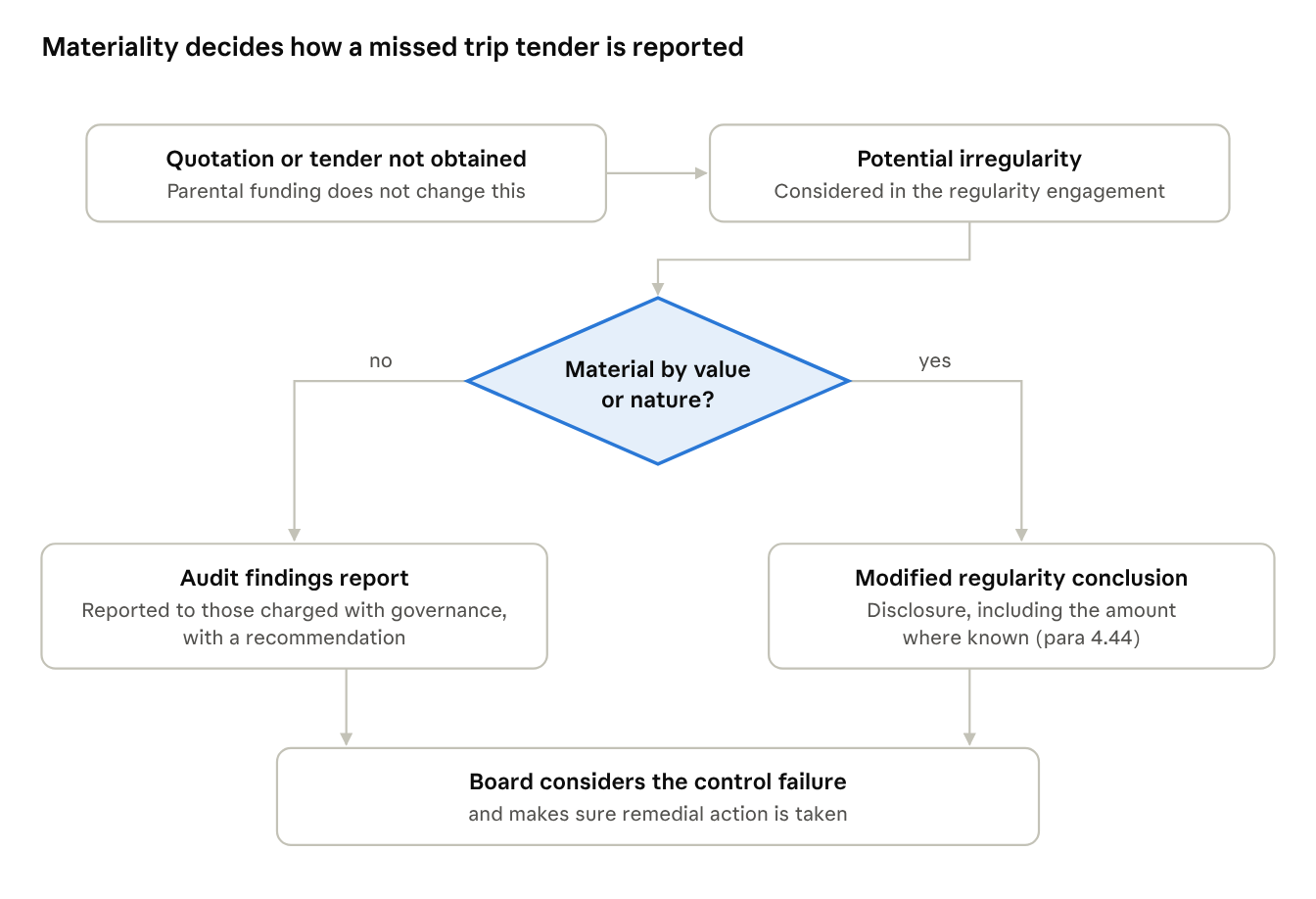
Whether the matter ends in the audit findings report or a modified conclusion depends on the reporting accountant's judgement of materiality, by value and by nature.
What this means for your trust
If your trust collects trip money, contracts with suppliers in its own name and pays them itself, treat that spending like any other. In summary, the DfE's response means:
- Parental funding is not an exemption. Value for money, competitive procurement and your own financial regulations still apply.
- Your Financial Procedures Manual applies as written. If it makes no exception for educational trips, the DfE expects you to follow its quotation and tender thresholds for them.
- Charging and buying are separate questions. The charging guidance tells you whether parents can be asked to pay, not how to buy the trip.
- Statutory rules may also apply. Consider whether the Procurement Act 2023 and associated regulations apply to a particular purchase.
- Expect your auditor to test it. Missed quotations or tenders on trips will be considered as potential irregularities in the regularity engagement.
- Boards should act on control failures. The DfE expects the board to consider any failure and make sure remedial action is taken.
How we can help
Reckoner Audit works with academy trusts as external auditors and reporting accountants. We can help you review how trips and other parent-funded activities run through your financial controls and check your Financial Procedures Manual against your current practice.
Contact our academies team at info@thereckoner.co.uk to discuss your trust's arrangements.